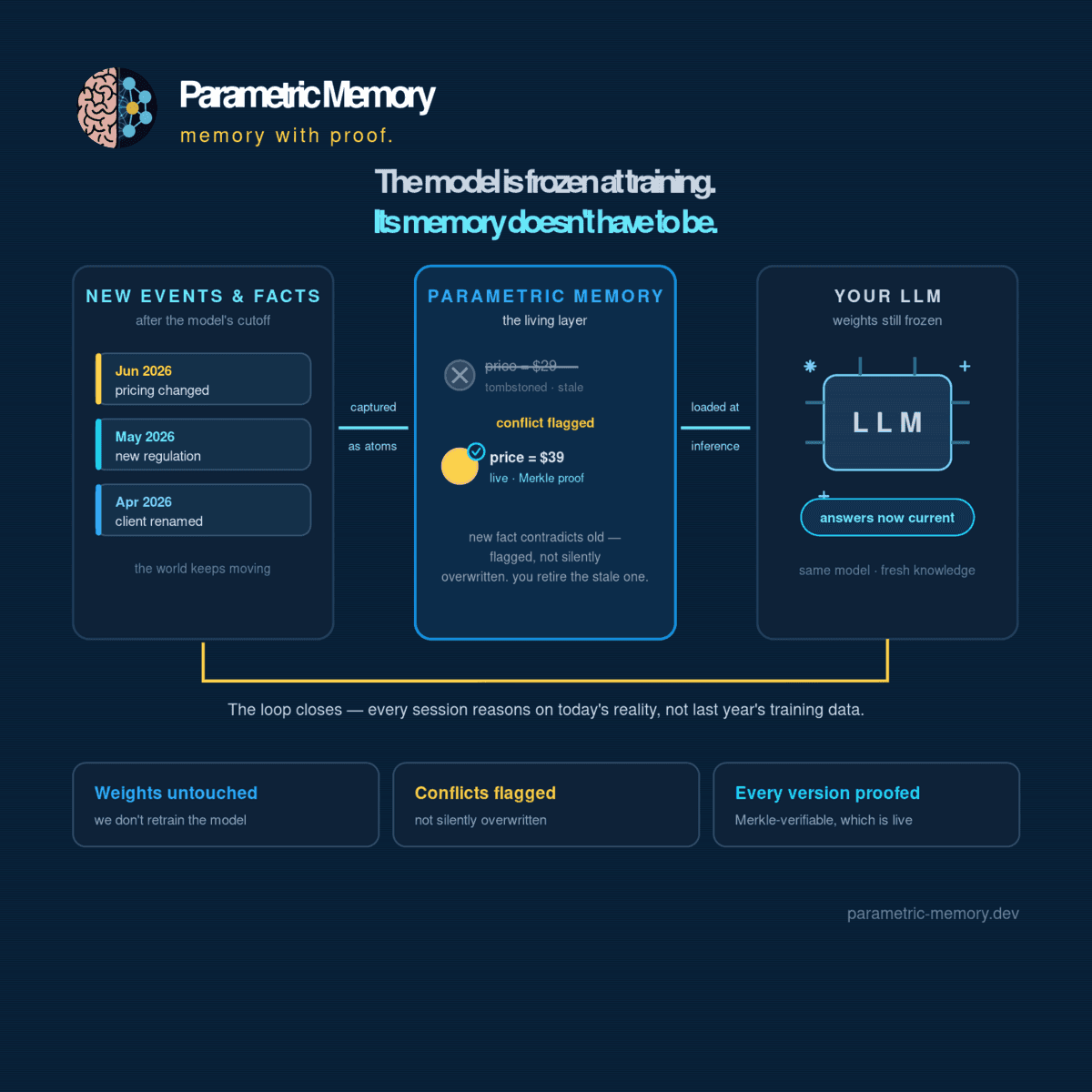
Every LLM you use is frozen in time. Its weights stopped learning the day training ended, so it carries yesterday's facts — and yesterday's mistakes — into every conversation you have today. Ask it about a price that changed last week, a teammate who left, or a decision you reversed yesterday, and it will answer with confidence from a world that no longer exists.
You can't retrain a frozen model on your own news. Fine-tuning is slow, expensive, and lossy, and it still bakes in a new cutoff the moment it finishes. But the model doesn't have to be the thing that remembers. You can give it a memory that isn't frozen, and let the weights stay exactly as they shipped.
That is what Parametric Memory does. The model is untouched. What changes is what it knows at the moment it answers.
The cutoff is a property of the weights, not of the task
A model's knowledge cutoff is a wall built into the parameters. Retrieval moved the wall by stuffing documents into the prompt, but most retrieval is a similarity guess against a vector store — it returns what's near your query, with no notion of what's true now versus what was true last quarter.
We treat memory differently. Every fact your agent learns is stored as an atom: a named, versioned string inserted into a SHA-256 Merkle tree. New events get captured as they happen, and the next time the agent works, the relevant atoms are already loaded into context. The cutoff stops being a wall and becomes a timestamp — one you keep moving forward.
// Capture a fact the model could never have known — it happened after training.
await session_checkpoint({
  atoms: [{
    atom: "v1.fact.primary_region_is_syd1",
    payload: "Production substrate host moved to syd1 on 2026-06-20.",
  }],
});
That alone isn't novel — a notes file does roughly the same thing. The hard part is what happens when new information contradicts the old.
The part that matters: contradiction, not accumulation
A frozen model will repeat a stale belief forever, fluently, with no signal that it's wrong. A notes file or a vector store will happily hold both the old fact and the new one and let the retriever flip a coin. Neither tells you which version is live.
In Parametric Memory, a new fact that conflicts with an existing one is flagged, not silently overwritten. You tombstone the version that's no longer true — it's replaced in the tree with a tombstone hash (64 zeros) that preserves the proofs of its siblings — and the agent stops acting on it. The history isn't erased; it's superseded, and you can prove which version the agent is allowed to use right now.
// The region changed again. Supersede the old fact and prove the new one is live.
await session_checkpoint({
  atoms: [{
    atom: "v1.fact.primary_region_is_fra1",
    payload: "Production substrate host moved to fra1 on 2026-06-24.",
  }],
  tombstone: ["v1.fact.primary_region_is_syd1"],
  edges: [{
    source: "v1.fact.primary_region_is_fra1",
    target: "v1.fact.primary_region_is_syd1",
    type: "supersedes",
  }],
});
Now when the agent recalls the region, it gets the live atom back with a Merkle proof — an audit path from the leaf to the tree root that you can verify in O(log n) without trusting the server:
{
  "atom": "v1.fact.primary_region_is_fra1",
  "payload": "Production substrate host moved to fra1 on 2026-06-24.",
  "proof": { "leaf": "9f2c…", "root": "a4e1…", "auditPath": ["…","…"], "index": 41 }
}
The stale syd1 atom is still in the tree's history — tombstoned — so an auditor can see that it existed and was retired, and an RFC 6962 consistency proof shows the tree evolved honestly between the two versions. The agent never sees it as a live fact again.
Closing the loop
Put together, the loop is simple and it never stops turning:
- Something happens in the real world.
- You record it as an atom — and if it contradicts what was known, you tombstone the old version.
- It feeds back into the next session's context, ranked to the agent's objective.
- The agent reasons on today's reality instead of last year's training data.
The model stays frozen. The memory stays alive. And because every fact carries its own proof, you don't have to choose between "current" and "trustworthy" — you get both, and you can show your work.
Frozen model. Living memory.
So here's the question worth asking about your own stack: what's the most expensive thing your AI still believes because nobody told it the world changed — and could you prove, today, which version of that belief it's acting on?
Parametric Memory is MCP-native — Claude, Cursor, and other compatible clients connect and gain persistent, verifiable memory immediately. See the docs to set up your own substrate.