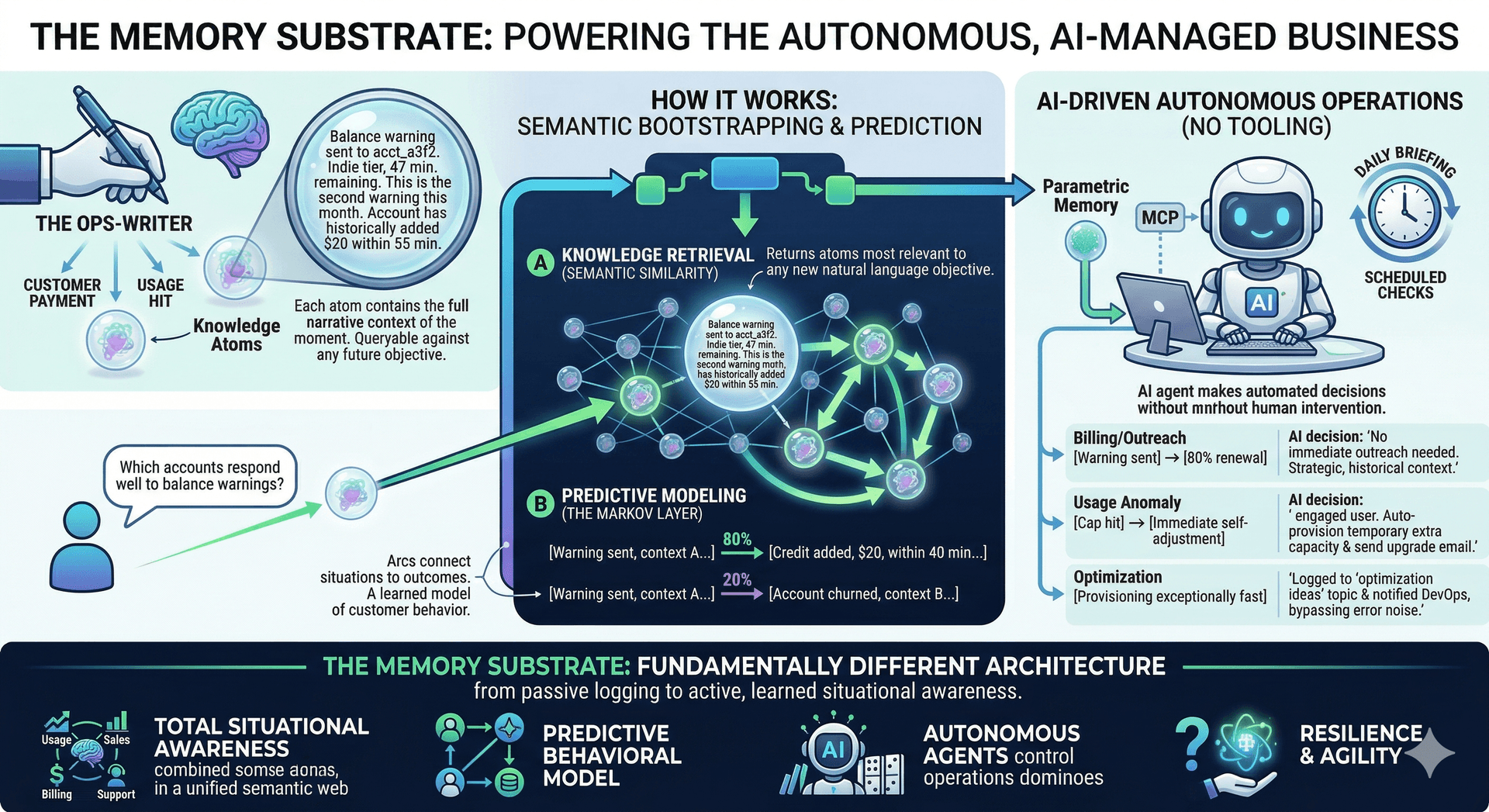
In our last discussion, we explored a radical shift in how businesses operate: moving away from rigid, fragile databases and toward a Memory Substrate—a living, narrative memory of your business that an AI can query to provide total situational awareness.
But this raises a fascinating question about architecture. If we are no longer designing database schemas (rows, columns, and foreign keys), what are we designing?
The answer is both simple and profound: We are designing the "Atoms."
An atom, in the context of a memory substrate, is a single unit of narrative knowledge. But here is the breakthrough—these atoms shouldn't just be generic text dumps. Just as developers used to define rigid data types for an SQL database, modern system architects can "program" the semantic structure of these atoms specifically for the domain they operate in.
We aren't programming code; we are programming context.
Moving from Data Types to Semantic Types
Think of it like this: If you drop an AI into a sea of generic event logs, it has to work incredibly hard to figure out what matters. But if you design the shape of the memory itself, the AI instantly becomes an expert in your specific business.
We can create different "species" of atoms, structured to capture the exact contextual signals that matter most to a specific industry.
1. The Engineering Substrate: The "Developer Atom"
Imagine a software development team using an AI to manage their SDLC (Software Development Life Cycle). A generic log would just say: PR #402 Merged by User_Dave.
But a semantically programmed Developer Atom is designed to encode technical behavior, project milestones, and architectural intent. When a piece of code is committed, the Ops-Writer generates an atom structured like this:
"Pull Request #402 merged by Dave. Component: Authentication. This PR addresses the technical debt flagged last week regarding token expiration. It took 3 days from review to merge, indicating slight friction in the staging environment. This completes Milestone 2 of the Q3 Security Epic."
Because this atom was programmed to care about intent, friction, and milestones, the AI agent reading the substrate can now answer questions like: "Which parts of our codebase are slowing down the team?" or "Are we accumulating architectural debt faster than we are shipping features?"
2. The Commerce Substrate: The "Operations Atom"
Now, take that exact same technology and apply it to an e-commerce platform. The AI doesn't care about pull requests; it cares about revenue, security, and buyer friction.
A Commerce Atom is programmed to structurally encode the customer's journey, billing anomalies, and marketing touchpoints. When a checkout fails, the system doesn't log an Error 500. It writes an atom like this:
"Checkout abandoned by User_Sarah at the shipping calculation step. Cart value: $140. User was routed here from the 'Spring Sale' email campaign. This is their 3rd abandoned cart this month, but they have zero history of fraud signals. They are a high-LTV customer who typically buys with free shipping."
Because this atom was designed to care about campaign origin, lifetime value (LTV), and fraud context, the AI can autonomously decide the next best action. It reads the substrate, recognizes the semantic pattern, and instantly triggers a highly personalized, one-time free shipping code to Sarah's email. No human marketer required.
The Power of Domain-Driven Memory
This is what makes the Memory Substrate so incredibly powerful. You aren't buying a one-size-fits-all AI tool. You are creating a custom-fit brain for your operations.
By defining what an "Atom" looks like for your specific use case, you dictate what the AI learns.
In Healthcare: A "Patient Atom" is programmed to capture symptom progression, medication adherence, and subjective pain scales, allowing the AI to flag potential readmission risks.
In Logistics: A "Transit Atom" is programmed to capture weather delays, vendor reliability, and route deviations, allowing the AI to predict supply chain cascades before they happen.
The New Role of the Architect
For business owners and technical leaders, this is incredibly liberating. You no longer have to pay thousands of dollars for bloated, industry-specific SaaS tools just to get decent dashboards.
Instead, your primary architectural job shifts from building rigid data pipelines to designing the narrative structure of your business. You decide what context matters. You program the shape of the atoms. And then, you let the AI read the memory, connect the dots, and run the business.